Boutique hotel
A new brand system and a fast booking site so guests book with the hotels, not through intermediaries.
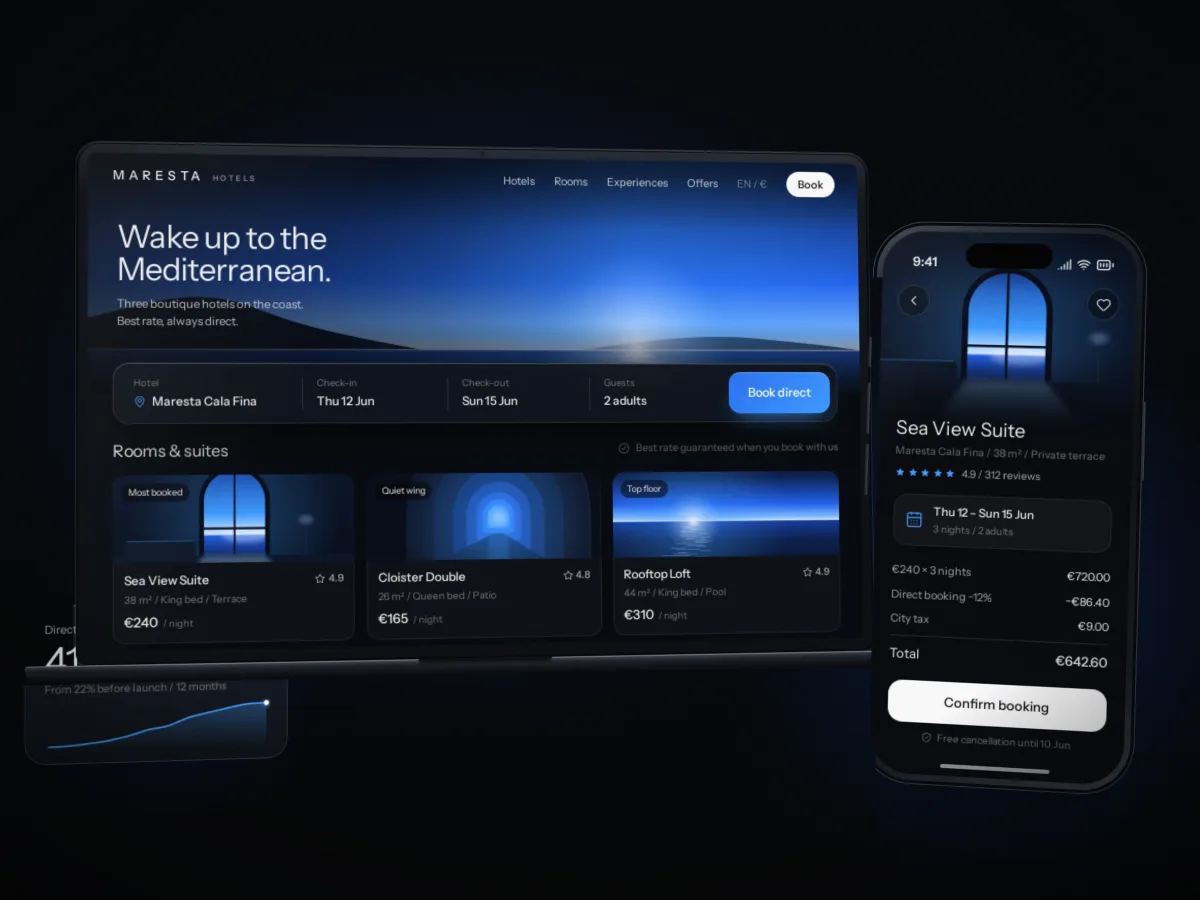
Situation and baseline
A 42-room independent hotel receives most online reservations through travel marketplaces. Direct traffic exists, but room details, availability and booking are split between pages and an external engine. The modelled baseline is 22% direct share, 1.1% mobile conversion and 4.8-second mobile LCP.
The challenge
Reduce intermediary dependence without hiding their value, while preserving rate parity, inventory accuracy and the personal service of a small property.
Approach and timeline
Diagnose
Reconcile analytics, booking events and channel reports; separate branded demand from discovery and define how commission savings are estimated.
Design
Restructure room, location and policy information around guest questions, simplifying the path from availability to confirmed reservation.
Integrate
Connect the booking engine, test availability and rate parity, then audit the highest-volume mobile journeys.
Learn and refine
Review direct share, conversion, cancellations and acquisition cost by source; keep experiments small and reversible.
Agents, automations and stack
A supervised guest-intent assistant answers approved questions from hotel content and routes reservations or exceptions to staff. It never sets rates, promises availability or handles payment data. The reference stack connects a booking engine, analytics and consent-aware reporting.
Deliverables
- Guest journey and channel baseline
- Mobile booking experience, event map and staff escalation plan
Outcome indicators
- Direct booking share
Baseline: 22% Target: 41%
- OTA commission avoided
Baseline: — Target: €186,000
- Mobile booking conversion
Baseline: 1.1% Target: 2.6%
- Largest Contentful Paint
Baseline: 4.8 s Target: 1.6 s
How we measure
Direct share is direct reservations divided by all reservations in the same period. Mobile conversion follows eligible sessions to confirmed booking. Commission avoided is estimated from matched reservations and contract rates, not incremental profit. LCP uses the 75th percentile of real mobile visits.
Risks and guardrails
Keep the booking engine authoritative for rates and inventory; disclose material policies before payment; respect analytics consent; route unusual requests to staff and do not infer sensitive guest traits.
What comes next
Validate seasonality across a full trading cycle, compare new and returning guests, then consider a separately supervised pre- and post-stay pilot.