Smart logistics
Orders, incidents and invoices flow on their own, and the team sees the day’s numbers every morning.
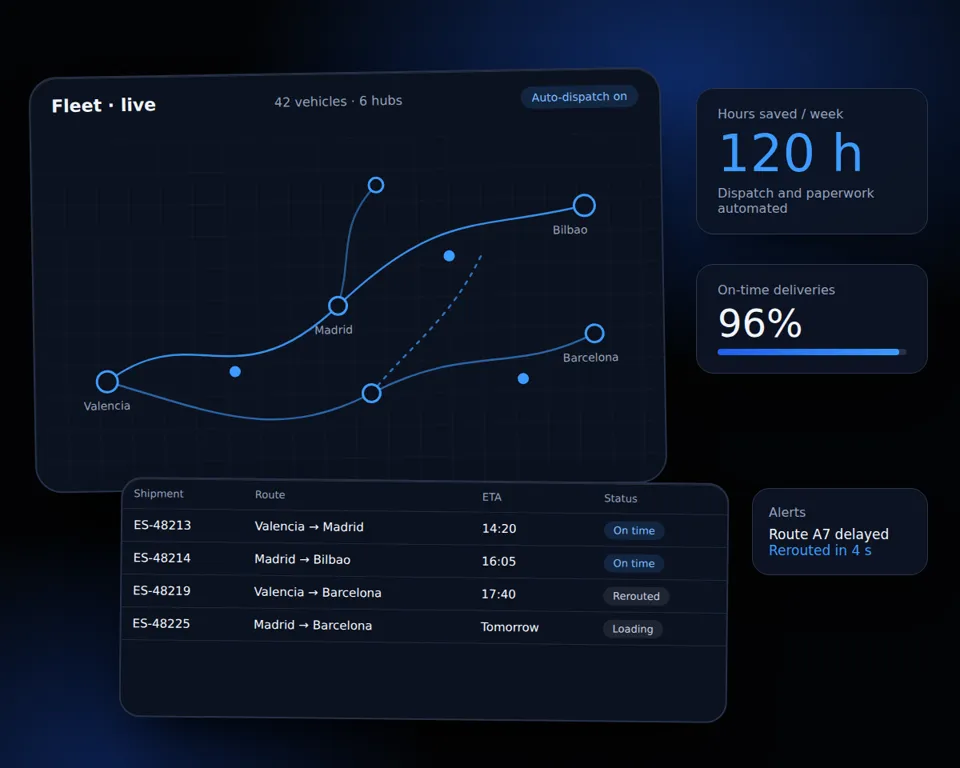
Situation and baseline
A regional operator tracks shipments across carrier portals, customer messages and internal sheets. Teams spend time checking routine status while delayed or conflicting events can go unnoticed until a customer asks.
The challenge
Reduce repetitive checks and surface exceptions earlier without presenting estimates as confirmed events or creating false service commitments.
Approach and timeline
Diagnose
Compare carrier events with internal milestones, find stale or contradictory data and assign an owner to each exception class.
Design
Define severity, confidence, customer impact and response windows with operations and account teams.
Integrate
Consolidate signals, deduplicate alerts and prepare an evidence-linked work queue with suggested next steps.
Learn and refine
Run in shadow mode, measure missed and unnecessary alerts, then enable approved notifications with a pause path.
Agents, automations and stack
An event agent normalizes carrier updates and flags late, missing or inconsistent milestones. A workflow agent drafts internal summaries and routes incidents to an accountable coordinator. Customer messages remain approval-gated when confidence is low or contractual impact is possible.
Deliverables
- Event-source and ownership map
- Exception queue, audit trail and notification rollback plan
Outcome indicators
- Coordinator hours released
Baseline: — Target: 120 h
- Exception rate
Baseline: 4.1% Target: 1.3%
- Manual status checks
Baseline: 9 Target: 2
- On-time milestone rate
Baseline: 91% Target: 98%
How we measure
Released hours are time-study estimates against sampled manual checks. Exception rate uses eligible shipments and a defined actionable exception. Manual checks are validated from workflow records and samples. On-time metrics use agreed windows and disclose unavailable source events.
Risks and guardrails
Preserve timestamps and provenance, surface stale data, never infer delivery from a scan alone, log suggestions and human decisions, and retain manual dispatch during outages.
What comes next
Add carrier coverage incrementally, compare alert precision by lane and consider customer-facing status only after accuracy and contract review are stable.